
May is Melanoma and Skin Cancer Awareness Month, an important time to raise awareness about the most common cancers in the United States. Skin cancer affects millions of Americans each year, but the encouraging news is that many cases are preventable and highly treatable when detected early.
Dermatologists play a critical role in prevention, early detection, and treatment of skin cancer. Understanding the risk factors, warning signs, and prevention strategies can help patients take proactive steps to protect their skin.
Understanding Skin Cancer
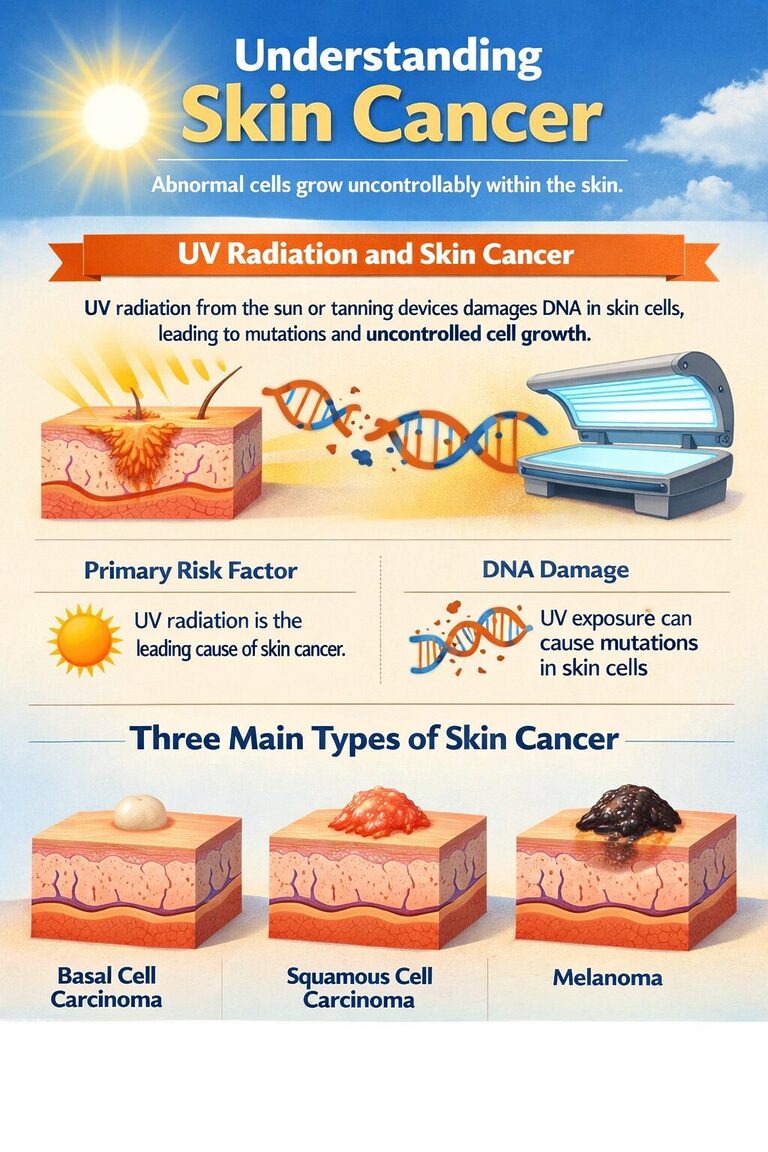 Skin cancer occurs when abnormal cells grow uncontrollably within the skin. Most skin cancers develop due to damage caused by ultraviolet (UV) radiation, primarily from sun exposure or indoor tanning devices.
UV radiation damages DNA within skin cells. Over time, this damage can accumulate and lead to mutations that trigger uncontrolled cell growth. Research in dermatologic oncology has demonstrated that UV radiation is a primary environmental risk factor for skin cancer development, particularly for melanoma and keratinocyte carcinomas.
There are three main types of skin cancer.
Basal Cell Carcinoma
Basal cell carcinoma (BCC) is the most common form of skin cancer. It arises from basal cells in the epidermis and typically develops on sun-exposed areas such as the face, ears, neck, and scalp.
BCC usually grows slowly and rarely spreads to other parts of the body. However, it can cause significant local tissue damage if left untreated. Studies show that cumulative UV exposure is strongly associated with the development of basal cell carcinoma.
Squamous Cell Carcinoma
Squamous cell carcinoma (SCC) develops from keratinocytes in the outer layer of the skin. Like basal cell carcinoma, SCC most commonly occurs in areas with chronic sun exposure.
Although many SCCs are treatable when detected early, they carry a greater risk of spreading to lymph nodes and other organs compared with basal cell carcinoma.
Chronic ultraviolet radiation exposure and cumulative sun damage play major roles in SCC development.
Melanoma
Melanoma is less common than basal or squamous cell carcinoma, but it is the most dangerous form of skin cancer because of its ability to spread rapidly throughout the body.
Melanoma develops from melanocytes, the pigment-producing cells that give skin its color. Research shows that intense intermittent UV exposure and blistering sunburns significantly increase melanoma risk.
Early detection dramatically improves outcomes. When melanoma is diagnosed at an early stage before it spreads, survival rates are extremely high.
Risk Factors for Skin Cancer
Skin cancer can affect anyone, but certain factors increase risk. Dermatologic research has identified several well-established risk factors.
Ultraviolet radiation exposure
UV radiation from sunlight and tanning beds is the most significant environmental risk factor. UV radiation damages cellular DNA and suppresses immune responses within the skin, contributing to cancer development.
Indoor tanning has been associated with an increased risk of melanoma, basal cell carcinoma, and squamous cell carcinoma.
Fair skin and light pigmentation
Individuals with fair skin, light hair, and light eyes have lower levels of melanin, the pigment that provides some natural protection from UV radiation.
History of sunburns
Research shows that blistering sunburns, particularly during childhood and adolescence, significantly increase melanoma risk later in life.
Family or personal history of skin cancer
Having a close relative with melanoma increases the likelihood of developing the disease. Patients who have had skin cancer previously also face a higher risk of developing additional skin cancers.
Numerous or atypical moles
Individuals with many moles (nevi) or atypical (dysplastic) nevi have an increased risk of melanoma.
Recognizing the Early Signs of Melanoma
Early detection is one of the most important tools in preventing serious outcomes from melanoma.
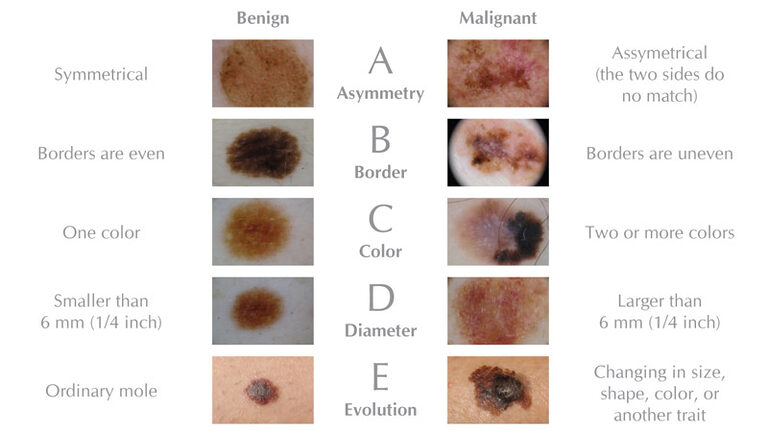
Dermatologists commonly recommend using the ABCDE rule to identify suspicious moles.
A – Asymmetry
One half of the mole does not match the other.
B – Border
Edges may be irregular, scalloped, or poorly defined.
C – Color
Multiple colors or uneven pigmentation may be present.
D – Diameter
Melanomas are often larger than 6 mm, though they can be smaller.
E – Evolving
Any mole that changes in size, shape, color, or symptoms should be evaluated.
In addition to these criteria, patients should watch for the “ugly duckling” sign—a mole that looks different from the others.
Research shows that visual recognition strategies such as the ABCDE rule improve early detection of melanoma.
Why Early Detection Matters
When melanoma is detected early, it is often confined to the top layer of skin and can be treated effectively with surgical removal.
However, once melanoma spreads to lymph nodes or other organs, treatment becomes more complex and survival rates decrease.
Dermatologic studies demonstrate that tumor thickness at diagnosis is one of the most important predictors of survival in melanoma. Early detection significantly improves outcomes, making routine self-exams and annual exams with a dermatologist essential.
The Importance of Regular Skin Exams
Skin cancer screening allows dermatologists to identify suspicious lesions before they become more advanced.
Patients should perform monthly self-examinations and schedule routine professional skin exams, particularly if they have risk factors for skin cancer.
During a professional skin exam, dermatologists evaluate moles, freckles, and other lesions using clinical expertise and tools such as dermoscopy to detect early signs of malignancy.
Early detection through screening is associated with thinner melanomas at diagnosis and improved survival outcomes.
Preventing Skin Cancer
While not all skin cancers are preventable, research consistently shows that reducing UV exposure significantly lowers risk.
Dermatologists recommend several evidence-based prevention strategies.
Use sunscreen daily
Broad-spectrum sunscreen protects against both UVA and UVB radiation. Regular sunscreen use has been shown to reduce the incidence of melanoma and other skin cancers.
SPF 30 or higher is recommended for daily protection.
Wear protective clothing
Wide-brimmed hats, sunglasses, and sun-protective clothing can help reduce UV exposure.
Seek shade during peak UV hours
UV radiation is strongest between 10 a.m. and 4 p.m. Limiting exposure during these hours can reduce cumulative sun damage.
Avoid tanning beds
Indoor tanning devices emit concentrated UV radiation and are strongly associated with increased melanoma risk.
Protect children from sunburns
Early life sunburns significantly increase melanoma risk later in life. Protecting children’s skin is an important preventive strategy.
Mohs Surgery and Skin Cancer Treatment
When skin cancer is detected, dermatologists may recommend several treatment options depending on the cancer type, location, and stage.
One of the most effective treatments for certain skin cancers—particularly on cosmetically sensitive areas like the face—is Mohs micrographic surgery.
Mohs surgery allows physicians to remove cancerous tissue layer by layer while examining each layer under a microscope. This approach helps ensure that all cancer cells are removed while preserving as much healthy tissue as possible.
Mohs surgery has some of the highest cure rates for basal and squamous cell carcinoma, making it a widely used treatment option for high-risk or recurrent skin cancers.
Skin Cancer Awareness Saves Lives
Skin cancer is extremely common, but awareness and prevention can make a powerful difference.
Melanoma and Skin Cancer Awareness Month serves as a reminder that protecting your skin today can reduce your risk tomorrow.
Regular sunscreen use, protective habits, and routine skin checks are simple steps that can significantly reduce skin cancer risk and support early detection.
If you notice a changing mole or have concerns about your skin, scheduling a professional skin exam with a dermatologist can provide reassurance and early treatment if needed.
Your skin is your body’s largest organ—taking steps to protect it is one of the most important investments you can make in your long-term health.