
Hair loss can be distressing, whether it happens unexpectedly, at a young age, or gradually as time passes. At DHE, our expert dermatology team understands how deeply hair loss can impact your confidence and emotional well-being. Whether your hair is thinning, falling out in patches, or disappearing from larger areas, we’re here to help you understand the cause and explore effective hair loss treatments tailored to your needs.
Understanding Hair Loss (Alopecia)
Alopecia is the medical term for hair loss. It can range from mild thinning to complete baldness and may be temporary or permanent. Hair loss can be caused by genetics, autoimmune disease, illness, hormonal changes, stress, medications, or underlying health conditions.
Types of Hair Loss
Hair loss comes in many forms. Proper diagnosis is the first step toward finding the right treatment. Below are some of the most common types of alopecia:
1. Alopecia Areata
One of the most common causes of sudden or patchy hair loss is alopecia areata, an autoimmune condition in which the body mistakenly attacks the hair follicles, leading to hair shedding. Alopecia areata occurs when the immune system targets the hair follicles, causing the hair to fall out in smooth, round patches on the scalp or body. This condition can affect people of any age, gender, or background, though it often starts in childhood, adolescence, or early adulthood.
Risk Factors:
- Family history of alopecia areata
- Autoimmune diseases like thyroid disease, type 1 diabetes, or lupus
- High levels of stress or trauma
While some people only experience one episode, others may have recurring flare-ups throughout life.
Types of Alopecia Areata
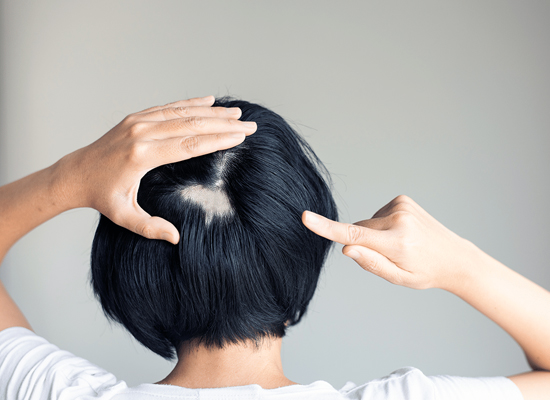
- Patchy alopecia areata: This is the most common form of alopecia areata, involving coin-sized patches of hair loss, usually on the scalp but also potentially on areas of the face, eyebrows, or body.
- Diffuse Alopecia Areata: Instead of round patches, diffuse alopecia areata causes sudden overall thinning of the scalp hair. It can resemble female or male pattern baldness, making it harder to diagnose without a clinical evaluation.
- Ophiasis Alopecia: This less common form of alopecia causes a band-like pattern of hair loss along the sides and lower back of the scalp. It’s often more resistant to treatment than patchy alopecia areata.
- Alopecia Totalis: This advanced form of alopecia results in the complete loss of scalp hair. It may begin as patchy hair loss and progress over time.
- Alopecia Universalis: The most extreme form of alopecia areata, this involves the loss of all body hair, including eyebrows, eyelashes, facial hair, and body hair.
- Nail Changes (Nail Pitting): Some individuals with alopecia areata may notice tiny pits or ridges in their fingernails or toenails. This can be an additional sign of autoimmune activity in the body.
2. Androgenetic Alopecia
Better known as male-pattern or female-pattern hair loss, is the most common cause of thinning hair worldwide. It is a progressive condition driven by a combination of genetics, hormones (particularly dihydrotestosterone, or DHT), and age. Because it progresses silently for years before becoming obvious, early recognition and treatment are key to preserving the hair you have.
- How Does Androgenetic Alopecia Develop?
- Genetic sensitivity to DHT causes affected follicles—especially on the crown and frontal scalp—to shrink in a process called miniaturization.
- Each growth cycle becomes shorter, producing finer, lighter hairs until growth stops altogether.
- In women, the part line gradually widens; in men, recession and a thinning crown are typical.
- Who does Androgenetic Alopecia Affect?
- Men: Up to 50 % will notice visible thinning by age 50, some as early as their late teens.
- Women: About 40 % experience noticeable volume loss by menopause, though it can begin much earlier.
- A family history on either side increases risk, but pattern, onset, and speed of loss vary greatly—even among relatives.
- How is Androgenetic Alopecia Diagnosed?
- History & Visual Exam – We map the pattern and pace of loss, family history, hormonal changes, and lifestyle factors.
- Dermatoscopic Evaluation – A handheld scope magnifies follicles, revealing miniaturization and confirming the diagnosis without a biopsy in most cases.
- Laboratory Screening (when needed) – We may check iron, thyroid, or androgen levels—especially for women with sudden or diffuse shedding—to rule out overlapping causes such as telogen effluvium or hormonal imbalance.
3. Telogen Effluvium
Is a temporary, non-scarring form of diffuse hair shedding triggered when physical, emotional, or metabolic stress pushes more follicles than usual into the resting (telogen) phase at once. Because hairs fall out roughly 2-3 months after the inciting event, the connection is often overlooked, yet identifying and addressing that trigger is the key to recovery.
- How Does Telogen Effluvium Develop?
- Stress signal: Illness, surgery, hormonal shifts, crash dieting, major life events, or certain medications disrupt the normal hair-growth cycle.
- Synchronized fallout: Up to 30 % of follicles enter telogen simultaneously (versus the normal 10 %), creating a noticeable “shed” 8–12 weeks later.
- Self-limiting course: Once the trigger resolves, follicles usually re-enter the growth (anagen) phase within 3-6 months, though visible regrowth can lag.
- Common Triggers
- Physiologic stress such as high fever, COVID-19/Flu, major surgery, childbirth
- Hormonal changes like discontinuing estrogen-containing contraceptives and thyroid imbalances
- Nutritional factors like crash dieting, protein or iron deficiencies, or rapid weight-loss
- Medications such as beta blockers, anticoagulants, anticonvulsants, GLP-1s, and some antidepressants
- Psychological stress like bereavement, job loss, or a significant mental health episode
- Who does Telogen Effluvium Affect?
- Everyone with sufficient stress exposure can develop TE, but it is especially common in:
- Women in the first 3-4 months after childbirth
- Individuals recovering from severe infections (including long COVID)
- Patients tightening calorie intake or starting/stopping weight-loss drugs
- People with undiagnosed thyroid or iron disorders
- Everyone with sufficient stress exposure can develop TE, but it is especially common in:
- How is Telogen Effluvium Diagnosed?
- Detailed History – We map life events, illnesses, medications, and diet over the previous six months.
- Scalp & Pull Test – Gentle traction removes >4–6 full-length hairs, each showing a club (telogen) root.
- Dermatoscopy – Confirms uniform shaft diameter (miniaturization would suggest AGA instead).
- Targeted Labs – Iron studies, TSH, vitamin D, and—in select cases—ferritin or zinc to uncover silent deficiencies.
4. Traction Alopecia
Is hair loss caused by chronic mechanical pulling on the follicles, most often from tight hairstyles, extensions, chemical processing, or headwear that places repetitive tension on the scalp. Unlike genetic or hormonal hair loss, TA is entirely preventable and, when caught early, fully reversible; prolonged traction, however, can scar follicles permanently.
- How Does Traction Alopecia Develop?
- Constant tension (braids, ponytails, locs, weaves, tight headscarves, helmets) strains follicles at the root.
- Inflammation & mini-breakage weaken shafts, causing them to snap or shed before the growth cycle finishes.
- Follicular scarring can occur after months-to-years of unrelieved stress, leading to permanent recession—most commonly along the frontal and temporal hairlines.
- Who Does Traction Alopecia Affect?
- Individuals who wear tight, long-term hairstyles such as braids, cornrows, sleek buns, high ponytails, locs
- Hair extensions such as sew-ins, micro-links, bonded tracks, and tape-ins
- Chemical and thermal stressors such as repeated relaxers or keratin straightening with flat-ironing
- Occupational or athletic gear such as swim caps, helmets, or military headgear
- Young children and dancers who regularly wear ballet buns or competition cheer ponytails
- Recognizing and Diagnosing Traction Alopecia
- Early “fringe sign,” which shows short, broken hairs or fine baby hairs lining an otherwise receding edge.
- Perifollicular erythema or papules, which is redness and bumps that signal ongoing inflammation.
- Symmetrical pattern along the areas of greatest pull (frontal, temples, behind ears, nape).
- Dermatoscopy shows decreased follicular density but normal shaft diameter, distinct from androgenetic alopecia’s miniaturization.
- History of styling practices corroborates mechanical cause; biopsies rarely needed unless scarring is suspected.
5. Scarring (cicatricial) Alopecias
Are a diverse group of inflammatory disorders in which the hair-follicle stem cells are destroyed and replaced by fibrous scar tissue. A proper diagnosis from a board-certified dermatologist is essential to determine the exact cause of your hair loss and design an effective treatment plan.
- How Does Scarring Alopecia Develop?
- Inflammatory attack on the follicle: Auto-immune or granulomatous cells infiltrate the follicular epithelium, targeting the bulge area where stem cells live.
- Permanent follicle loss: Once stem cells are obliterated, the follicle cannot regenerate, leading to irreversible bald patches that may slowly expand.
- Triggering factors vary by subtype:
- Lichen planopilaris & frontal fibrosing alopecia: A T-cell–mediated auto-immunity, often in peri- and post-menopausal women.
- Discoid lupus erythematosus: An immune complex deposition linked to cutaneous lupus.
- Central centrifugal cicatricial alopecia: a confluence of genetic predisposition, follicular fragility, and chronic heat/chemical styling.
- Folliculitis decalvans & dissecting cellulitis: Neutrophilic inflammation, sometimes driven by Staphylococcus aureus or altered microbiome.
- Who Does Scarring Alopecia Affect?
- Although anyone can develop a cicatricial alopecia, certain patterns emerge:
- Sex & Age:
- Women 40–70 years: frontal fibrosing alopecia, lichen planopilaris.
- Men 20–50 years: folliculitis decalvans, dissecting cellulitis.
- Ancestry:
- Central centrifugal cicatricial alopecia disproportionately affects individuals of African descent.
- Auto-immune predisposition: Patients with lupus, Hashimoto’s thyroiditis, vitiligo, or other connective-tissue diseases have higher risk for lymphocytic subtypes.
- Scalp environment: Repetitive chemical relaxers, hot-comb use, or chronic bacterial folliculitis can precipitate or exacerbate neutrophilic variants.
- Sex & Age:
- Although anyone can develop a cicatricial alopecia, certain patterns emerge:
- How is Scarring Alopecia Diagnosed?
- Comprehensive History: Onset speed, symptoms (burning, itching, tenderness), associated auto-immune conditions, hairstyling practices, and medication use.
- Dermatoscopy (Trichoscopy): Reveals hallmark features such as absent follicular openings, perifollicular scale, tufted follicles, or perifollicular erythema, all clues that distinguish lymphocytic from neutrophilic disease.
- Targeted Scalp Biopsy: A small plug of tissue taken at the active, inflamed margin is examined for follicular destruction pattern (lymphocytic vs. neutrophilic vs. mixed) and degree of fibrosis, guiding therapy.
- Laboratory Work-Up: ANA, anti-dsDNA, thyroid panel, or bacterial cultures are ordered when clinical suspicion of systemic lupus, thyroid disease, or infection arises.
Treatment Options for Alopecia
There is no permanent cure for alopecia, but several treatments can stimulate regrowth, reduce inflammation, and help manage flare-ups. Treatment depends on the type of alopecia, the patient’s age, and other health conditions.
1. Corticosteroid Injections
This is the most common treatment for small patches of alopecia areata. The injections are placed directly into the affected areas to reduce inflammation and allow hair follicles to regrow.
- Administered every 4–6 weeks
- Minimal discomfort
- Best for localized patches
- Not effective for other types of hair loss
2. Topical Minoxidil (Rogaine)
Minoxidil helps stimulate hair growth by increasing blood flow to the hair follicles and is available over the counter or by prescription. It’s often used in combination with other treatments. It can be helpful for many types of alopceia.
- Applied once or twice daily to the scalp
- Safe for long-term use
- Takes several months to see results
3. Topical or Oral Immunosuppressants
These medications suppress the immune system’s attack on hair follicles, and oral medications can be effective for more widespread hair loss.
- Examples include methotrexate, cyclosporine, or corticosteroid creams
- Used with careful monitoring by your provider
- Can be useful for managing autoimmune hair loss
4. JAK Inhibitors (Biologics)
New FDA-approved oral medications called Janus kinase (JAK) inhibitors—such as baricitinib and ruxolitinib—target the immune response that causes alopecia areata.
- Ideal for moderate to severe alopecia areata
- Can result in significant regrowth
- May not be suitable for all patients; discuss risks and benefits with your dermatologist
- Not used to treat other types of hair loss
5. Lifestyle and Supportive Measures
- Stress management may help reduce flares
- Wigs, scarves, or hairpieces can help restore confidence
- Support groups and counseling can offer emotional support
What to Expect with Hair Regrowth
Hair regrowth varies from person to person. In mild cases, hair may return without treatment. For others, it may grow back but fall out again later. When hair begins to grow back, it often starts as fine or white hair, eventually returning to its normal color and texture, though this isn’t always the case.
Regular follow-up with your dermatologist is important to track progress, adjust treatments, and monitor for future flare-ups.
When to See a Dermatologist for Hair Loss
If you’re noticing sudden or unexplained hair loss, especially in patches or a thinning pattern, schedule a visit with a board-certified dermatologist. Early diagnosis can prevent further loss and improve the chances of regrowth. At DHE, we understand how upsetting hair loss can be, and we’re here to help. Our team will evaluate your scalp, identify the type of hair loss, and create a personalized treatment plan to help you regain your hair and confidence.